In evidenza

Il Cardinale Robert Sarah: verso un’autentica attuazione di «Sacrosanctum Concilium»

È di primaria importanza tornare il più presto possibile a un orientamento comune dei sacerdoti e dei fedeli, rivolti insieme nella medesima direzione — verso Est, o perlomeno verso l’abside —, verso il Signore che viene, in tutte le parti del rito in cui ci si rivolge al Signore. Tale pratica è permessa dalle regole liturgiche attuali. Ciò è perfettamente legittimo nel nuovo rito. In effetti, penso che una tappa cruciale è di fare in modo che il Signore sia al centro delle celebrazioni.

(…)

Dobbiamo cantare la liturgia, ovvero cantare i testi liturgici, rispettare le tradizioni liturgiche della Chiesa e apprezzare il vasto tesoro — che è il nostro — della musica sacra, in particolare la musica propria del rito romano, cioè il canto gregoriano. Dobbiamo cantare la musica sacra propria della liturgia, e non una semplice musica religiosa, o ancora peggio, dei canti profani.
Dobbiamo trovare un buon equilibrio fra le lingue volgari e l’uso del latino nella liturgia. Il Concilio non ha mai avuto l’intenzione d’insinuare che il rito romano fosse esclusivamente celebrato in lingua volgare. Aveva l’intenzione di accrescerne l’utilizzo, in particolare per le letture. Oggi dovrebbe essere possibile, in particolare con i mezzi di stampa moderni, facilitare la comprensione da parte di tutti quando nella liturgia eucaristica è usato il latino. Il latino è inoltre particolarmente appropriato per gl’incontri internazionali, quando la lingua volgare non è compresa da tutti.

(…)

Là dove l’inginocchiamento e la genuflessione sono scomparsi nella liturgia, devono essere ristabiliti, in particolare per la ricezione di nostro Signore nella santa comunione.

Testo completo qui. Complete text in English here. Texte complet en Français ici.

Bishop Schneider on what his mother’s tears taught him about Communion in the hand

From Advaticanum website:

Q: The Catholic Bishops’ Conference of Kazakhstan, with papal approval under Benedict XVI, made Communion kneeling and on the tongue the obligatory ordinary form and forbade Communion in the hand even for visitors. You have no extraordinary ministers, no female altar servers, and you have altar rails. How did that become possible, as this is almost unthinkable in much of Europe and North America?

Bishop Schneider: Well, first, they are the heirs of martyrs and confessors in Kazakhstan. And they had such a deep veneration for the Holy Eucharist—such a deep veneration. They could not imagine receiving our Lord standing. I know the old people still who suffered in the prisons. And I myself lived during the persecution in the underground Church in Kyrgyzstan. And then I was in Estonia. My parish priest was a holy priest who before, in Stalin’s time, was imprisoned in a concentration camp here in Kazakhstan. And he was a confessor, a living confessor. And he was my parish priest in Estonia. I made my first holy confession when I was ten years old with him. And he gave me my first Holy Communion; he prepared me, and my mother also. Therefore he instilled in us such a deep veneration for the Holy Eucharist, for the moment of Holy Communion.

And therefore, when we left for Germany, West Germany, at the end of ’73, I remember very well—I was almost thirteen—he gathered us. We were four children, and my parents, and he said, “Be careful. When you come to West Germany, there are some churches where Communion is given in the hand.” When my mother—I observed her—heard this, she reacted spontaneously. What a horror. She even cried. She was so shocked. “Is this possible?” And he said, “Yes, in West Germany, yes.” But he was not well informed. He said only in some churches. And he said, “Please don’t go to these churches where Communion is given in the hand”—a holy confessor priest. And my mother promised him, “We will never do it.” And then we came to Germany, and it was in all the churches the same situation.

When my mother said she had no other choice, she came home, I remember, and looked at us children: “Oh, my children, I cannot understand how people can treat our Lord in such a manner with Communion in the hand”, and she started to weep. And these tears of my mother inspired me later to write my small booklet, Dominus Est, on the dangers of Communion in the hand. And this is my booklet; the manuscript of my booklet Pope Benedict XVI approved personally in a personal letter to me, saying, “Your arguments are convincing.” He wrote this as Pope, personally to me.

In any case, and therefore, the bishops in Kazakhstan—it was nineteen years ago—said it is normal. We have to, out of respect for our confessors and even still surviving people in our parishes from the old times who suffered persecution, make sure that Communion is really received kneeling and on the tongue, and that foreigners must adapt themselves.

So I think I would wish every bishop in the world, every bishops’ conference, to do the same. This was, in the entire Catholic Church until 1969, the rule. More than a thousand years, and strictly observed. However, the dam was opened, and then came the flood. And who opened the dam? The Pope, Paul VI. We must be honest, please. He opened the door and allowed Communion in the hand. He made a consultation of all the bishops in the world in ’68, asking them if it would be meaningful and helpful to introduce Communion in the hand. And the majority of the bishops answered Pope Paul VI, “Please don’t allow it, because it will cause abuses, sacrileges, and a weakening of the faith.” These were the arguments.

And in spite of the warning of the bishops, in spite of these arguments, in spite of this, Paul VI opened the flood. This is a huge historical responsibility. He had to say, “No, I will not allow it.” I consider that Communion in the hand has caused irreverence and sacrileges in the Church, and is still causing them. It is one of the deepest wounds in the body of the Church and must be healed, of course, slowly.

But the first thing which must be done to restore the health of the body of the Church is to stop Communion in the hand. And it must be done by the Pope again. The Holy See opened the flood, and the Holy See must close it again. And of course, with gradual steps, but it must be done.

Communion in the Hand: Ancient Norm, Humanist Myth, or Protestant Rebellion?

Because the Apostles understood the Mass from day one, they understood it to mean exactly what the Church would later teach about it. They also understood the priesthood itself. Consequently, from the very dawn of the Church, a distinction existed between the ordained and the laity, not only in the administration of the sacraments in general, but also in matters concerning the Most Holy, namely, the handling of the Blessed Sacrament. Therefore, I doubt that the touching of the Blessed Sacrament by unordained faithful could ever have been the norm, rather than a deviation from it; in other words, that it was a legally permitted default practice.

Zsolt Orbán’s full essay is available here.

La Comunión en la mano: ¿norma antigua, mito humanista o rebelión protestante?

Dado que los Apóstoles comprendieron la Misa desde el primer día, la entendieron exactamente en el sentido en que la Iglesia enseñaría más tarde sobre ella. También comprendieron el propio sacerdocio. En consecuencia, desde los albores mismos de la Iglesia existió una distinción entre los ordenados y los laicos, no solo en la administración de los sacramentos en general, sino también en las cuestiones relativas a lo Santísimo, es decir, en la manipulación del Santísimo Sacramento. Por ello, dudo de que tocar el Santísimo Sacramento por parte de fieles no ordenados pudiera haber sido alguna vez la norma, en vez de una desviación respecto de ella; dicho de otro modo, una práctica ordinaria legalmente permitida.

Ensayo completo por Zsolt Orbán aquí.

Papa Leo XIV de sanctā Missā linguā Latinā

Dall’intervista rilasciata da papa Leone XIV a Elise Ann Allen:

“Si può celebrare la Messa in latino adesso. Se si tratta del rito del Vaticano II, non c’è problema”.

From the interview given by Pope Leo XIV to Elise Ann Allen:

“You can say Mass in Latin right now. If it’s the Vatican II rite there’s no problem.”

De la entrevista concedida por el Papa León XIV a Elise Ann Allen:

“Ahora mismo se puede celebrar la Misa en latín. Si se trata del rito del Vaticano II, no hay problema.”

Gregorian Chant Academy Free Workshop

Struggling to Learn Gregorian Chant? This Free Workshop Is for You.
Read Square Notes, Pronounce Clearly, and Sing with Confidence–Even Without Formal Training
A simple, sacred framework for learning chant—designed for beginners with busy lives and no musical background.

RESOURCES
GCA’s (Christopher’s) independent chant tracks/digital albums:
https://www.gregorianchantacademy.com/store
Other recommended ensembles for listening:
● Monks of Solesmes (directed by Dom Jean Claire is best)
● Monks of Fontgombault
● Monks of Santo Domingo de Silos
● Nuns of Le Barroux (album title: “Voices: chant from Avignon”)
● Nova Schola Gregoriana and In Dulci Jubilo (both directed by Msgr Alberto Turco)
Free PDF Book: Beginners Guide to Reading Square Notation:
https://www.ststephenvc.com/wp-content/uploads/2020/02/beginner-guide-chant .pdf
Gregobase (chant pdfs): https://gregobase.selapa.net/scores.php
Sheet music Apps:
● Square Note
● Chant Tools
● Liber Pro
Chant Music App: Neumz (https://neumz.com/)
Church Latin Pronunciation Guide: https://www.adorientem.it/pdf/ModernPronunciationOfEcclesiasticalLatin.htm

Disorientation 180º

In this wonderful article, Fr Pius Noonan teaches us something obvious; but long forgotten- both words and gestures matter. Whatever ideas we express and the language we use to express them must converge on the meaning we intend. This meaning is both captured and expressed in the actions we perform in the service of those ideas. This is perhaps nowhere more important than in those gestures that accompany the Holy Sacrifice of the Mass. In particular, how we orientate our worship.

There are many causes of confusion that did not begin with Pope Francis. The position of the altar and the direction of celebration of the Mass is certainly one of them. We can now affirm that until the altars recover their proper position and the priest stands with the people towards the Lord, who is symbolised by the rising sun, there can be no hope for clarity, and confusion will continue to wreak havoc. The Christian people will continue to be afflicted with what we can only identify as a form of cognitive dissonance, stemming directly from the divide created in their minds and hearts by the innate longing of the Christian soul for Christ, the centre and focus of our prayer, while at the same time being forced to look at each other instead of at Christ. Lex orandi, lex credendi. If we observe the apostolic form of worship, we will have the apostolic faith, and our hearts will find rest. If we persist in not observing the norms of the apostles, our faith will always be wanting. It will remain confused, both for ourselves and for the world, and this is not a good situation to be in, for, as is well known, the Devil fishes in murky waters.

Read the full article by Father Pius Noonan here.

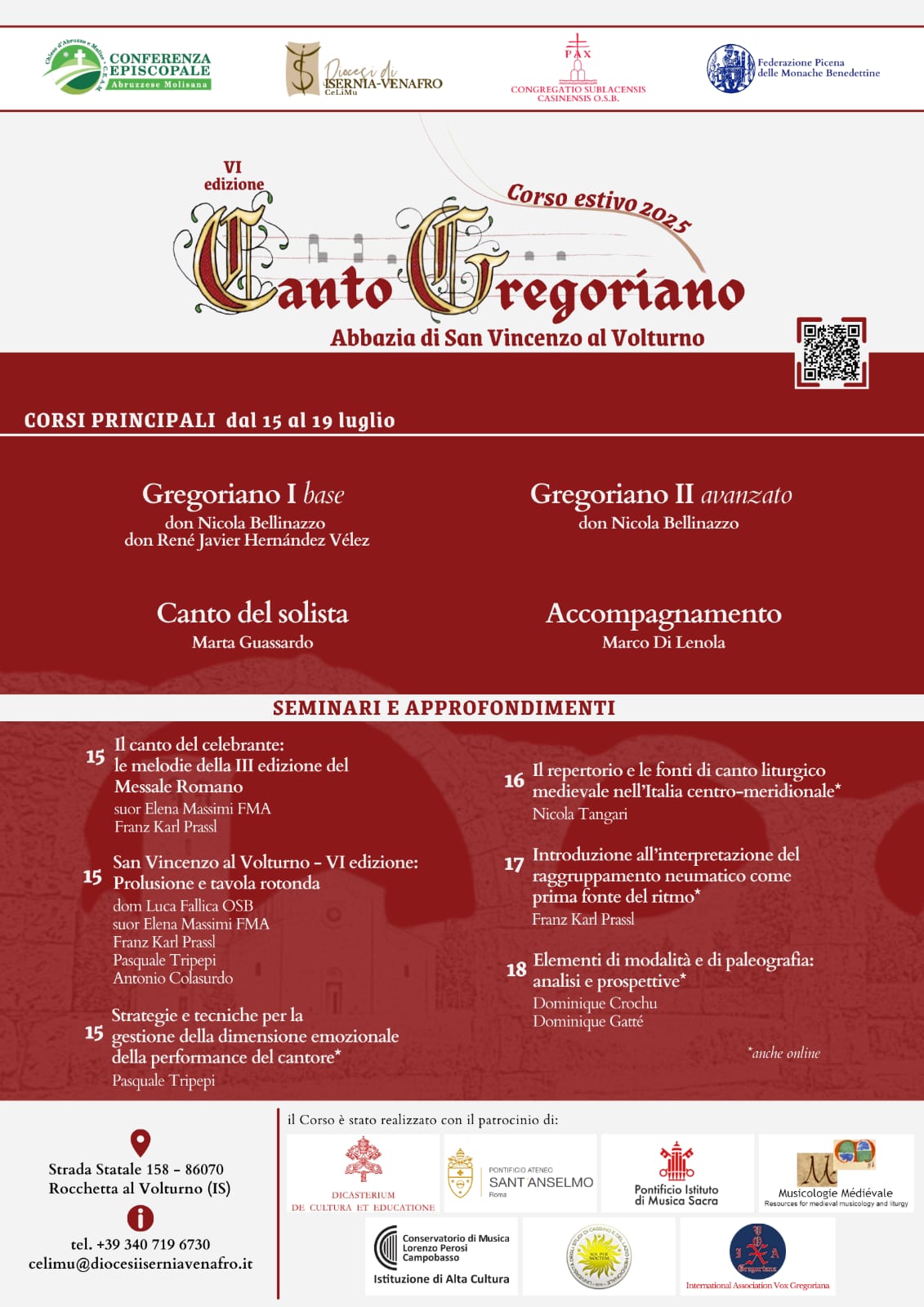
Corso estivo di Canto gregoriano all’Abbazia di San Vincenzo al Volturno

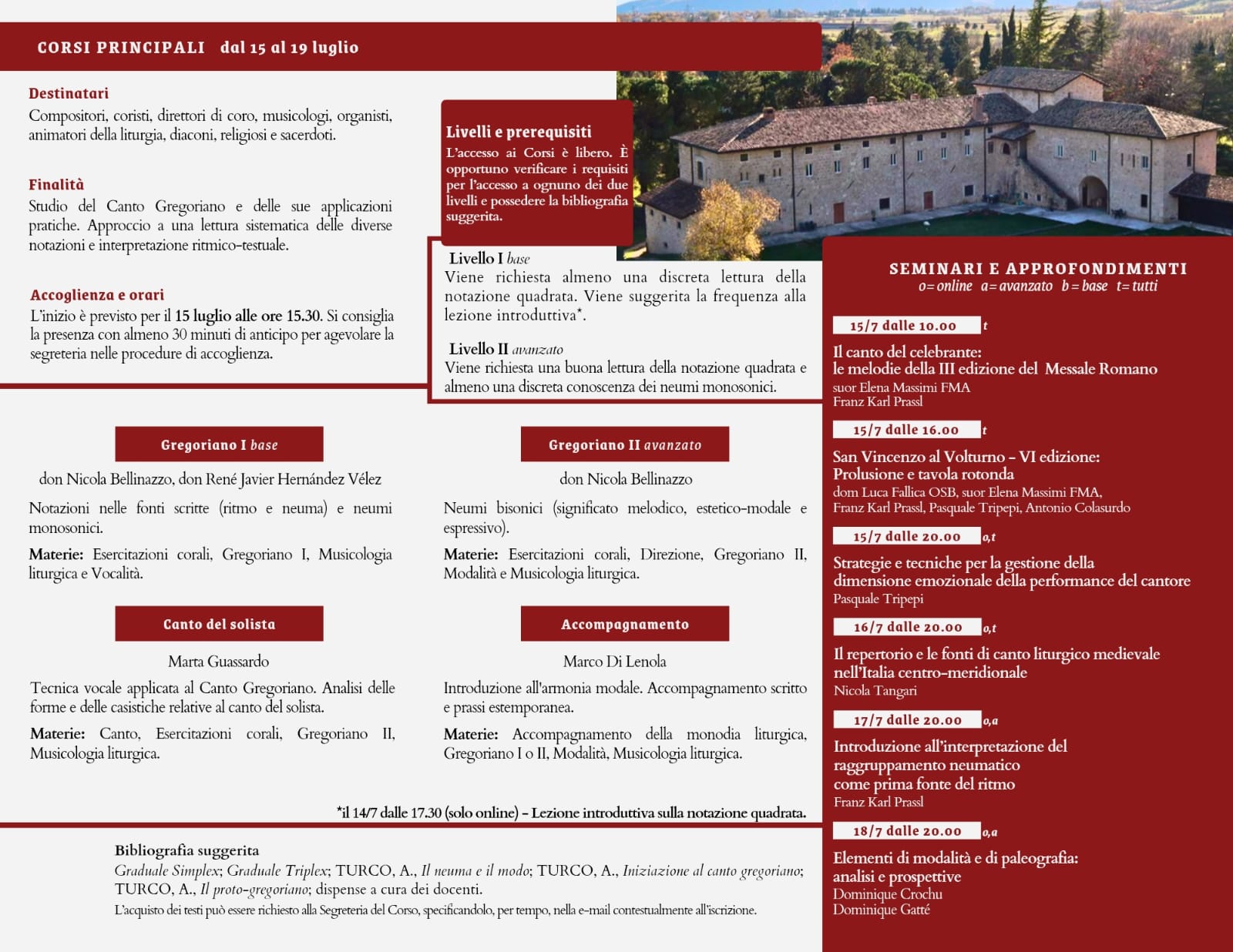
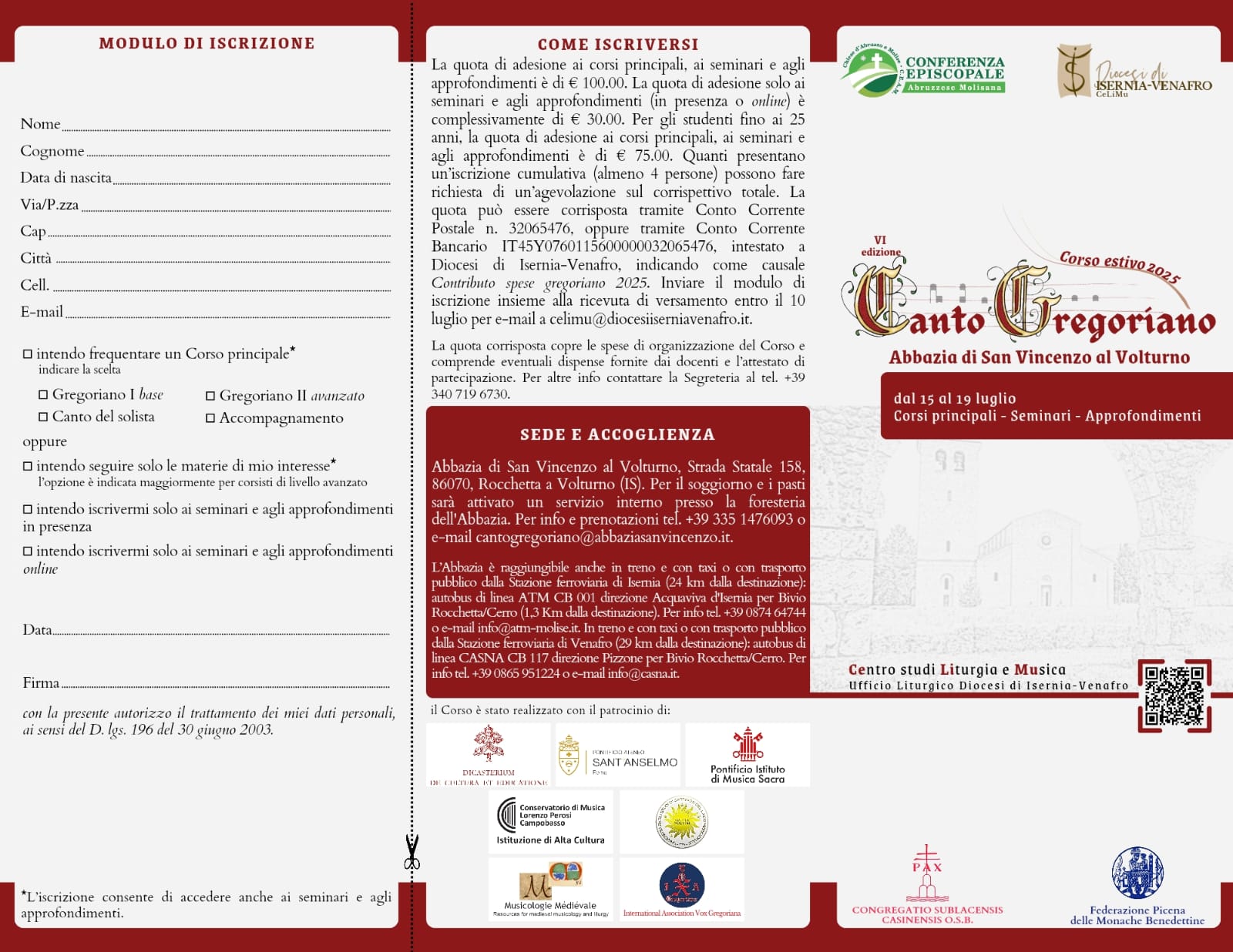
Organizzato dal Centro Studi Liturgia e Musica dell’Ufficio Liturgico della Diocesi di Isernia-Venafro – con il favore della Conferenza Episcopale Abruzzese Molisana, della Congregazione benedettina Sublacense Cassinese e della Federazione Picena delle Monache benedettine e con il patrocinio del Dicastero dell’Educazione e della Cultura presso la Santa Sede, del Pontificio Ateneo Sant’Anselmo, del Pontificio Istituto di Musica Sacra, del Conservatorio di Campobasso, dell’Università degli Studi di Cassino, di Musicologie Médiévale e di Vox Gregoriana – il corso si terrà dal 15 al 19 luglio 2025 presso l’Abbazia di San Vincenzo al Volturno.

Questo corso, che rappresenta un appuntamento di riferimento per chiunque voglia avvicinarsi o approfondire il canto gregoriano, è aperto a tutti, senza limiti di esperienza; infatti, l’obiettivo è quello di offrire un percorso formativo completo, accessibile e strutturato per ogni livello di conoscenza.

Gli insegnanti di altissimo livello guideranno i partecipanti attraverso un’esperienza di studio intensiva, che spazia dalle basi del canto gregoriano fino agli approcci più avanzati per coloro che desiderano perfezionarsi. Tra i corsi offerti, ricordiamo: Gregoriano I (base) – con Don Nicola Bellinazzo e Don René Javier Hernández Vélez; Gregoriano II (avanzato) – con Don Nicola Bellinazzo; Canto del Solista – con Marta Guassardo; Accompagnamento – con Marco Di Lenola.

Anche quest’anno, il Corso ospiterà Seminari di approfondimento con esperti e studiosi di fama nazionale e internazionale come Suor Elena Massimi (Ufficio Nazionale – CEI), Franz Karl Prassl (Graz), Pasquale Tripepi, Antonio Colasurdo, Nicola Tangari, Dominique Crochu e Dominique Gatté (Solesmes). Il Corso verrà inaugurato dalla prolusione dell’Abate di Montecassino Dom Luca Fallica OSB e si chiuderà con la consegna degli attestati di partecipazione da parte del Vescovo di Isernia-Venafro e di Trivento Sua Ecc. Rev.ma Mons. Camillo Cibotti.

Per informazioni, rivolgersi all’indirizzo mail celimu@diocesiiserniavenafro.it o al numero telefonico 340 719 6730.